Eru - Su Trmr Dem-Sum
· Une minute de lecture

Eru trmr dem-sum. Vej sa vom krmr pai-deg sos. Aru-dem trmr dem sa luk.
Fna-Aru osa Fna-Bra-Sel. Mai-Eru osa Rezenderu osa Hu osa Endric u trmr dem-sum sa Eru. Dem das u kamse dem-sum pus.
Posts related to Linguistics
Voir tous les tagsEru trmr dem-sum. Vej sa vom krmr pai-deg sos. Aru-dem trmr dem sa luk.
Fna-Aru osa Fna-Bra-Sel. Mai-Eru osa Rezenderu osa Hu osa Endric u trmr dem-sum sa Eru. Dem das u kamse dem-sum pus.
During Arusian's evolution, lenition was a constant and strong process that affected several roots, leading to the weakening or disappearance of consonants in the middle. This process also happened in languages like French and Danish, causing many sounds to vanish and words to sound way shorter than their etymological equivalents in the previous stages.
In Arusian, lenited consonants that don't vanish usually become fricatives -- more specifically, an uvular fricative.
Examples:
| Eru/Early Middle Arusian | Arusian |
|---|---|
| mandei | marei |
| kamt er | kamr |
| aclei | arei |
| segza | sera |
Complex NPs in Arusian, that is, NPs that don't have only a single noun/root inside, are usually nominalised CPs. Unlike in English, many NP structures with a noun, a determiner and an adjective are actually clauses in Aru. Beware that they often don't translate word for word between the two languages, so literal translations are extremely likely to fall apart.
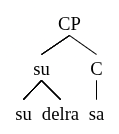
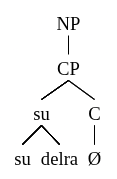
Clauses in Aru usually have the form X sa Y (SA can undergo allomorphy to -S which is enclitic to the noun or Ø when the second element is a VP). Su delras is a CP meaning "he rules". If one wants to nominalise it and use it as if it were an NP, meaning "the one who rules" -- which is basically a "ruler", "governor" or "king" -- you replace the SA copula by Ø, which is the nominaliser. It yields su-delra, which can be used as a noun.
Some Minimalistic Program trees of both structures:
CP[Su delras]
NP[[CP su delras]]
In this post we will show you some peculiarities of Arusian Pragmatics across the three dimensions: person, time and place.
In Arusian, you can order elements in the sentence to promote or demote the persons (actors). Promoted words come first in the sentence, and demoted words come closer to the end of the sentence. Arusian has a so-called hierarchichal word order based on the aforementioned concept.

In this post you will learn how to conjugate and declinate every noun and verb in the Arusian language. Since the language is mostly analytic/isolating (actually halfway), most of the declension and conjugation will be based on glueing other morphemes to the base root.
| Root | duwa — waste | lara — arrow | luwa — water |
|---|---|---|---|
| Transitive Agent Verb | duwar — to waste | larar — to point to | luwar — to wetten |
| Transitive Patient Verb | duwase — wasted by | larase — pointed at by | luwase — wetten by |
| Nominalised Agent Verb | duwaa — act of wasting | laraa — act of pointing | luwaa — act of wetting |
| Nominalised Patient Verb | duwaai — being wasted | laraai — being pointed at | luwaaai — being wet |
| Agent Noun | su-duwaai — one who wastes | su-laraa — one who points | su-luwaa — thing that wettens |
| Patient Noun | su-duwaai — thing that is wasted | su-laraai — one who is pointed | su-luwaai — thing that is wet |
Arusian root system is extremely flexible, therefore you can build your own words for things that the Arusian dictionary still doesn’t have a name for. Despite the flexibility, there are a few rules you should follow to make your words sound native and natural. With less than 600 roots, you can describe anything in Arusian, although, sometimes, some speakers might prefer borrowings. In Standard Arusian, however, there is a preference for native roots over borrowings, given that borrowings are hard to adapt due to the restrictive nature of Arusian phonology. There is a limited set of syllables/moræ based on the initial consonant + rhymes structure, similar to many Asian languages, like Mandarin, Cantonese, Vietnamese, only to name a few.
Keyem-dem sa kut u degreis u segr 1990 u wemr juwa-tek sa Noam Chomsky semr. Keyem pus u sa puwei sa 2 wei tuwause: Puwei-dem? Puwei-kei sa so kamr jef pus? X-Bar peyekse keyem pus u wemr Bare Phrase Structure (Deyau-Arek Auwekreis). “Move” (Ak) osar “Agree” (Dlai) u sa so oremr sasa ag.
Work in progress!
The Arusian language is restrictive concerning syllable structure, as it only allows a fixed set of syllables to be used in building new words.
Arusian syllables in general never end with /e/, /ow/ or /i/; they never begin with a vowel (even if they do seem to begin with a vowel, there is a glottal stop there); and they can end with /f/, /m/, /p/, /d/, /s/, /ʃ/, /z/, /ʒ/, /g/ and with /t/ and /k/ (which can alternate with /ʔ/ in faster or lazy speech). The following syllables are impossible in Arusian: bi, be, be, big, mig, vi, si, se, etc.
U and WEI are “special” pronouns in Arusian, because they don’t behave like other words and personal pronouns. In this article, we will explain their functions and why they can be considered resumptive pronouns.
Resumptive pronouns are a category of pronouns that simply refer back to an element already mentioned before. They are quite common in languages like Arabic, Hebrew, and Brazilian Portuguese. Although in Portuguese they are mostly optional, albeit common in speech, in Arabic and Hebrew they are mandatory in certain syntactic structures. In Arusian, the pronouns u and wei are also mandatory, as their omission can lead to ambiguity. Resumptive pronouns in Arusian allows you to make longer and more complex sentences.